
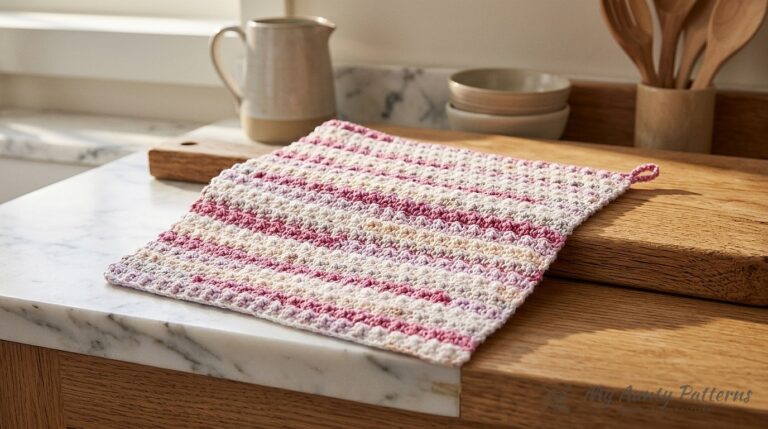
Farmhouse gingham and checkerboard textiles never go out of style in the kitchen, and this clever two-color tapestry crochet dishcloth creates the optical illusion of a three-shade woven plaid using only two balls of 100% worsted cotton yarn. By carrying the unused color strand flat across the tops of the previous row’s stitches and enclosing it inside each single crochet, the carried yarn peeks softly through the alternating 3-stitch blocks—producing crisp navy, cream, and blended chambray checks with a textured front-post border and built-in corner hanging loop.
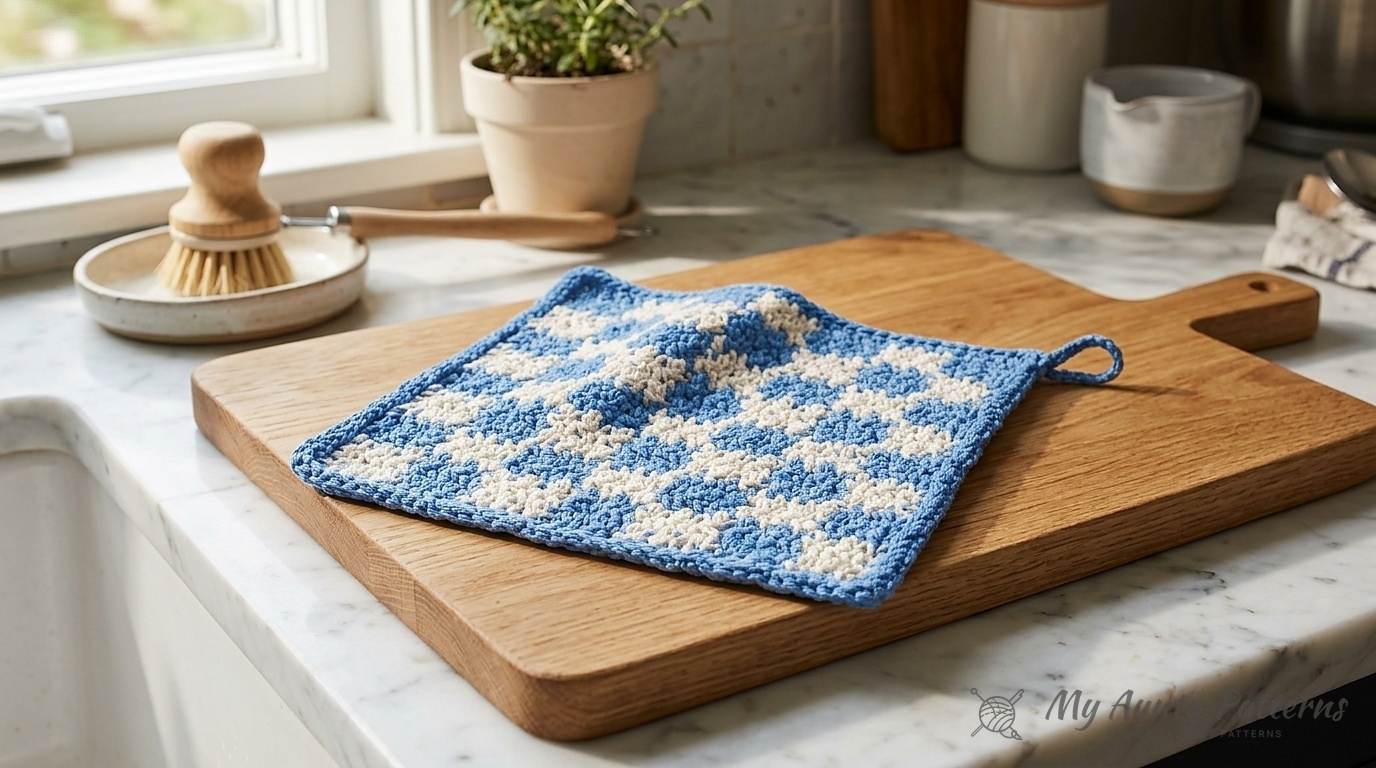
Pattern Terminology & Studio Notes: Written in standard US crochet terminology. This dishcloth uses Tapestry Crochet worked over a foundation chain multiple of 6 chains + 4 (yielding an odd number of 3-stitch color blocks). Because both yarns travel across every row, there are zero bobbins to untangle and only two yarn tails to weave in when you finish!
How 2-Color Tapestry Single Crochet Creates a 3-Tone Gingham Effect
Unlike traditional gingham patterns that require buying three separate yarn colors (dark, medium, and light), this pattern achieves a woven plaid look using just Contrast A (Blueberry) and Contrast B (Ecru):
- 3-Stitch × 2-Row Checkerboard Grid: Each square of the grid is 3 single crochets wide by 2 rows tall. Rows 1–2 start and end with 3 stitches of Blueberry (`A`), while Rows 3–4 start and end with 3 stitches of Ecru (`B`).
- Seamless Color Changes on the Final Pull-Through: On the 3rd single crochet of every block, you draw up a loop with the current color, then yarn over with the new color and draw through both loops on your hook so the top loop of the next stitch is already in the new shade.
- Textured Front-Post Single Crochet (
scfp) Border: Round 2 of the Ecru edging alternates 1 regularscwith 1scfparound the post of the stitch below, framing the checkerboard with a corded linen-stitch trim and a 12-chain hanging loop.
Materials, 100% Cotton Yarn Specs & 5-Size Kitchen Linen Table
The sample dishcloth is crocheted in Lily Sugar’n Cream (Category #4 Medium Worsted, 100% USA-grown cotton) using 1 ball of Blueberry (01712) and 1 ball of Ecru (00004) with a U.S. Size G/6 (4.0 mm) crochet hook. Non-mercerized 100% worsted cotton absorbs water immediately and softens with every hot-water wash.
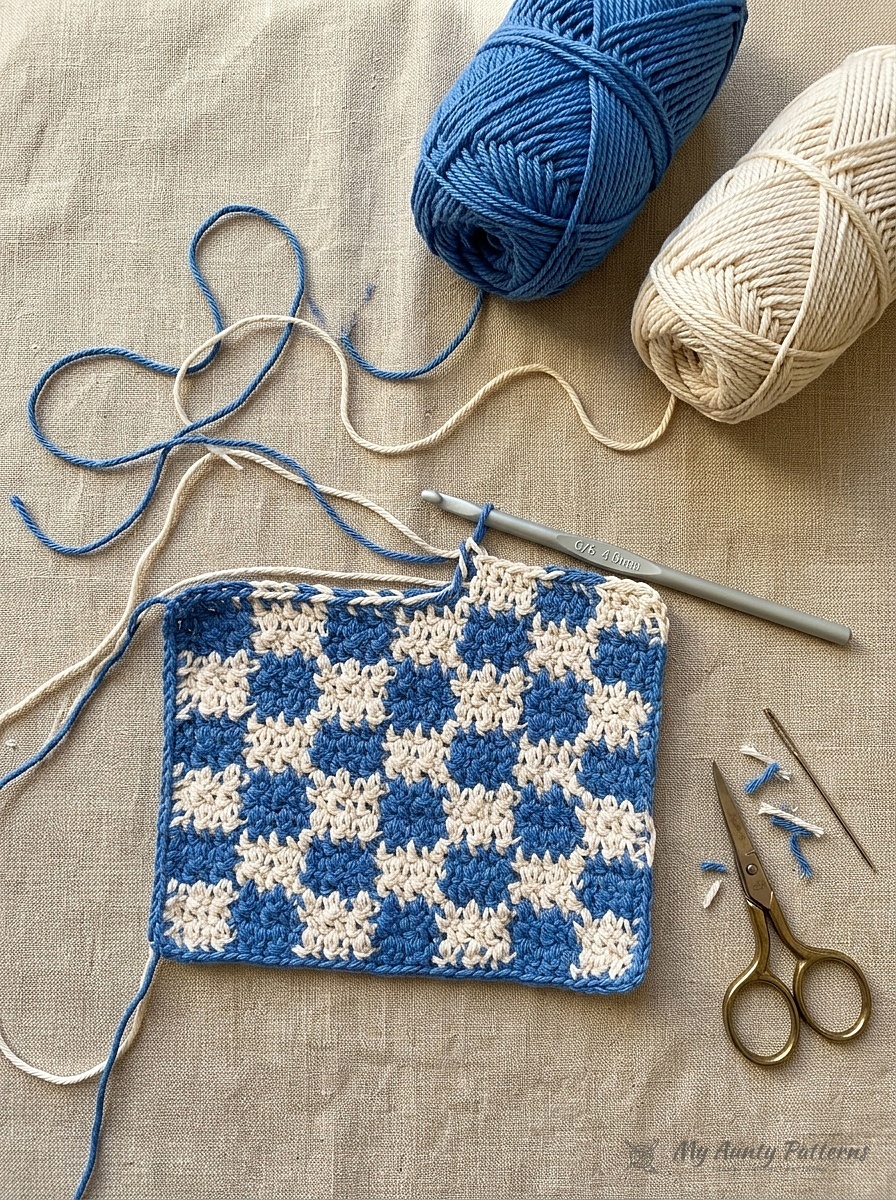
Materials & Tools Checklist
- Contrast A (Dark Shade): Lily Sugar’n Cream (2.5 oz / 70.9 g; 120 yds / 109 m) in Blueberry (01712) — 1 ball (approx. 55 yds used).
- Contrast B (Light Shade & Border): Lily Sugar’n Cream (2.0 oz / 56.7 g; 95 yds / 86 m) in Ecru (00004) — 1 ball (approx. 68 yds used).
- Crochet Hook: Size U.S. G/6 (4.0 mm) crochet hook, or size needed to obtain gauge.
- Notions: Blunt tapestry needle for weaving in cotton tails and sharp embroidery snips.
- Official Pattern Gauge: 15 single crochet and 16 rows = 4 inches (10 cm) in Tapestry Single Crochet pattern.
Swipe left or right on mobile to view all 5 kitchen linen sizes.
| Kitchen Linen Item | Finished Dimensions (Incl. Border) | Foundation Chain (Mult. of 6 + 4) | Row 1 Stitch Count (3-St Blocks) | Total Grid Rows | Worsted Cotton Yardage |
|---|---|---|---|---|---|
| Mug Coaster / Facial Scrubbie | 4.75 × 4.75 in. (12 × 12 cm) | Chain 16 | 15 sc (5 blocks) | 16 rows | 32 yds total (1 ball each) |
| Double-Thick Counter Trivet / Hotpad | 8 × 8 in. (20.5 × 20.5 cm) | Chain 28 | 27 sc (9 blocks) | 28 rows | 88 yds total (1 ball each) |
| Official Kitchen Dishcloth (Sample) | 9.5 × 9.5 in. (24 × 24 cm) | Chain 34 | 33 sc (11 blocks) | 36 rows | 123 yds total (1 ball A + 1 ball B) |
| Generous Spa Bath Washcloth | 11 × 11 in. (28 × 28 cm) | Chain 40 | 39 sc (13 blocks) | 42 rows | 165 yds total (2 balls each) |
| Farmhouse Kitchen Hand Towel | 12.5 × 19 in. (32 × 48 cm) | Chain 46 | 45 sc (15 blocks) | 72 rows | 310 yds total (2 balls A + 2 balls B) |
US Stitch Abbreviations & Tapestry Colorwork Rules
- Approx = Approximately
- Ch = Chain(s)
- Rep = Repeat
- Rnd(s) = Round(s)
- RS / WS = Right Side / Wrong Side
- Sc = Single crochet
- Scfp (Front Post Single Crochet) = Insert hook from front to back and to the front again around the vertical post of the next stitch; yarn over and draw up a loop, yarn over and draw through both loops on hook.
- Sl st = Slip stitch
- Sp(s) = Space(s)
- St(s) = Stitch(es)
- Tapestry Color Change Rule: Work the last single crochet before a color change up until 2 loops remain on the hook; drop the current color, yarn over with the new color, and draw through both loops to complete the stitch. Lay the unused strand flat along the top of the previous row and work your next 3 stitches over it to enclose it inside the fabric.
Row-by-Row Checkered Dishcloth & Border Instructions
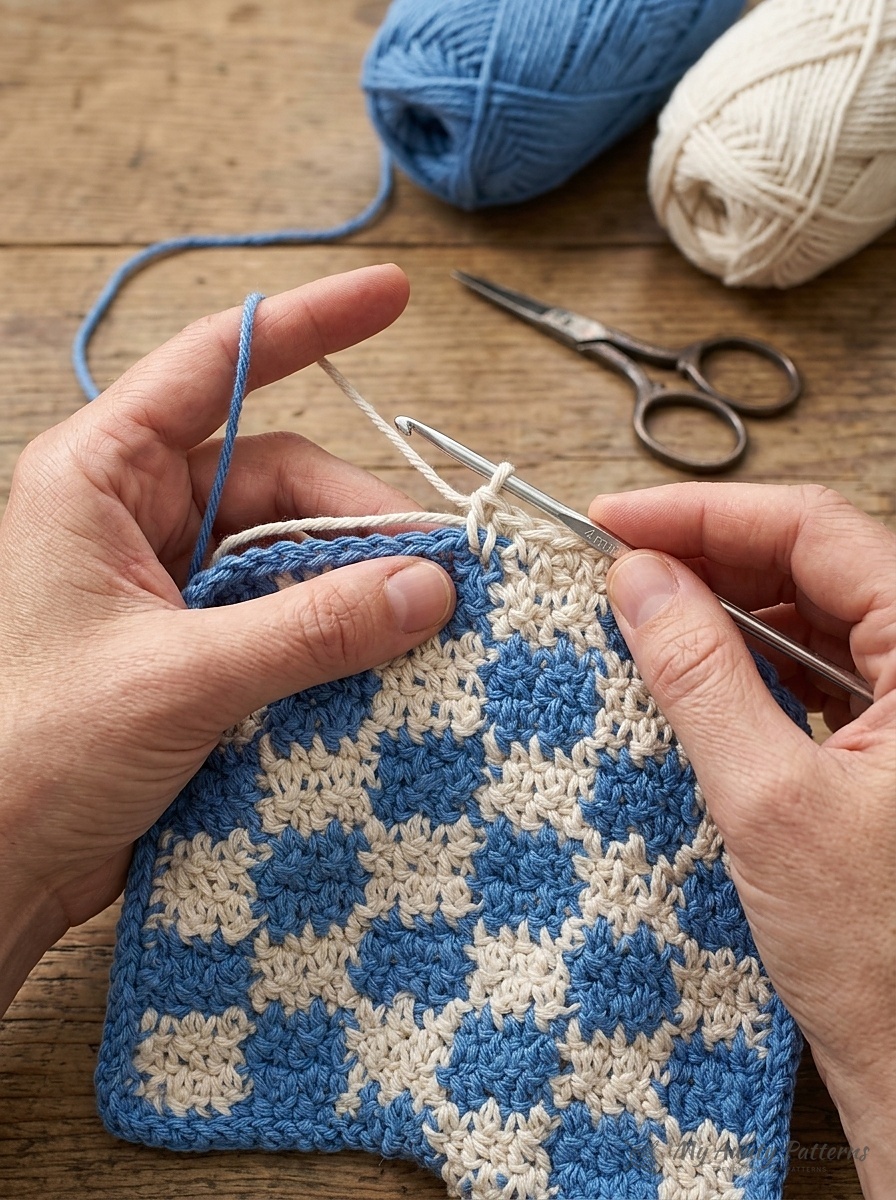
Stage 1: 4-Row Tapestry Checkerboard Repeat
Foundation: With U.S. G/6 (4.0 mm) crochet hook and Contrast A (Blueberry), chain 34.
Row 1 (Right Side): Working with A and joining Contrast B (Ecru) to carry along the top of the chain, work 1 sc in the 2nd chain from hook and 1 sc in each of the next 2 chains (changing to B on the 3rd stitch). *With B, work 1 sc in each of the next 3 chains (changing to A on the 3rd stitch). With A, work 1 sc in each of the next 3 chains (changing to B on the 3rd stitch). Repeat from * across to the end of the chain. Turn work, bringing both strands up at the turning edge. (33 sc total: six 3-sc blocks of A and five 3-sc blocks of B).
Row 2 (Wrong Side): With A, chain 1 (carrying B inside the stitches). Work 1 sc in each of the first 3 sc with A. *With B, work 1 sc in each of the next 3 sc. With A, work 1 sc in each of the next 3 sc. Repeat from * across to the end of the row, changing to B on the very last stitch of the row. Turn work. (33 sc).
Row 3 (Right Side – Staggered Check): With B, chain 1 (carrying A inside the stitches). Work 1 sc in each of the first 3 sc with B. *With A, work 1 sc in each of the next 3 sc. With B, work 1 sc in each of the next 3 sc. Repeat from * across to the end of the row. Turn work. (33 sc: six 3-sc blocks of B and five 3-sc blocks of A).
Row 4 (Wrong Side): With B, chain 1. Work 1 sc in each of the first 3 sc with B. *With A, work 1 sc in each of the next 3 sc. With B, work 1 sc in each of the next 3 sc. Repeat from * across to the end of the row, changing back to A on the very last stitch of the row. Turn work. (33 sc).
Rows 5–36 (Main Dishcloth Square): Repeat Rows 1 to 4 eight more times (36 rows total), until the piece forms a square. At the end of Row 36, cut Contrast A (Blueberry) and fasten it off; do not cut Contrast B (Ecru). Turn work so the Right Side is facing you to begin the border.
Stage 2: Front-Post Single Crochet Border & Corner Hanging Loop
Border Round 1 (Right Side): Continuing with Contrast B (Ecru), chain 1. Work 33 sc evenly across the top edge (Row 36), working (1 sc, ch 2, 1 sc) in the corner. Work 33 sc evenly down the left side row-ends, working (1 sc, ch 2, 1 sc) in the bottom corner. Work 33 sc across the underside of the foundation chain, working (1 sc, ch 2, 1 sc) in the corner. Work 33 sc evenly up the right side row-ends, working (1 sc, ch 2, 1 sc) in the final corner. Join with a sl st to the first sc. Do not turn.
Border Round 2 (Textured Post-Stitch Trim & Hanging Loop): Chain 1. *Work 1 sc in the first sc after the corner. *Work 1 scfp (front post single crochet) around the next sc, then work 1 regular sc in the next sc; repeat from * across to the corner ch-2 space. Work (1 sc, ch 2, 1 sc) into the corner ch-2 space. Repeat from * around all 4 sides, EXCEPT in the 4th (final) corner ch-2 space, work (1 sc, ch 12 for hanging loop, 1 sc). Join with a sl st to the first sc. Fasten off and weave in tails.
Mary’s Studio Tips for Crisp Tapestry Colorwork
- Smooth the Carried Strand Every 6 Stitches: Before completing the color change on the 3rd stitch of a block, gently tug the carried strand sitting inside the stitches just enough that it lies flat without bulging, then hold the piece wide so you don’t pull the fabric narrower.
- Wrap the Unused Yarn Around the Edge When Turning: At the end of Row 1 (where you keep working with A on Row 2), bring the unused B strand up around the side edge so it gets trapped inside the very first stitch of Row 2—leaving zero exposed floats along the sides.
- Why Pre-Washing Blooms the Checks: After blocking or running your finished cotton dishcloth through one warm wash cycle, the 100% cotton fibers swell slightly, locking the carried strands in place and softening the gingham transition squares.
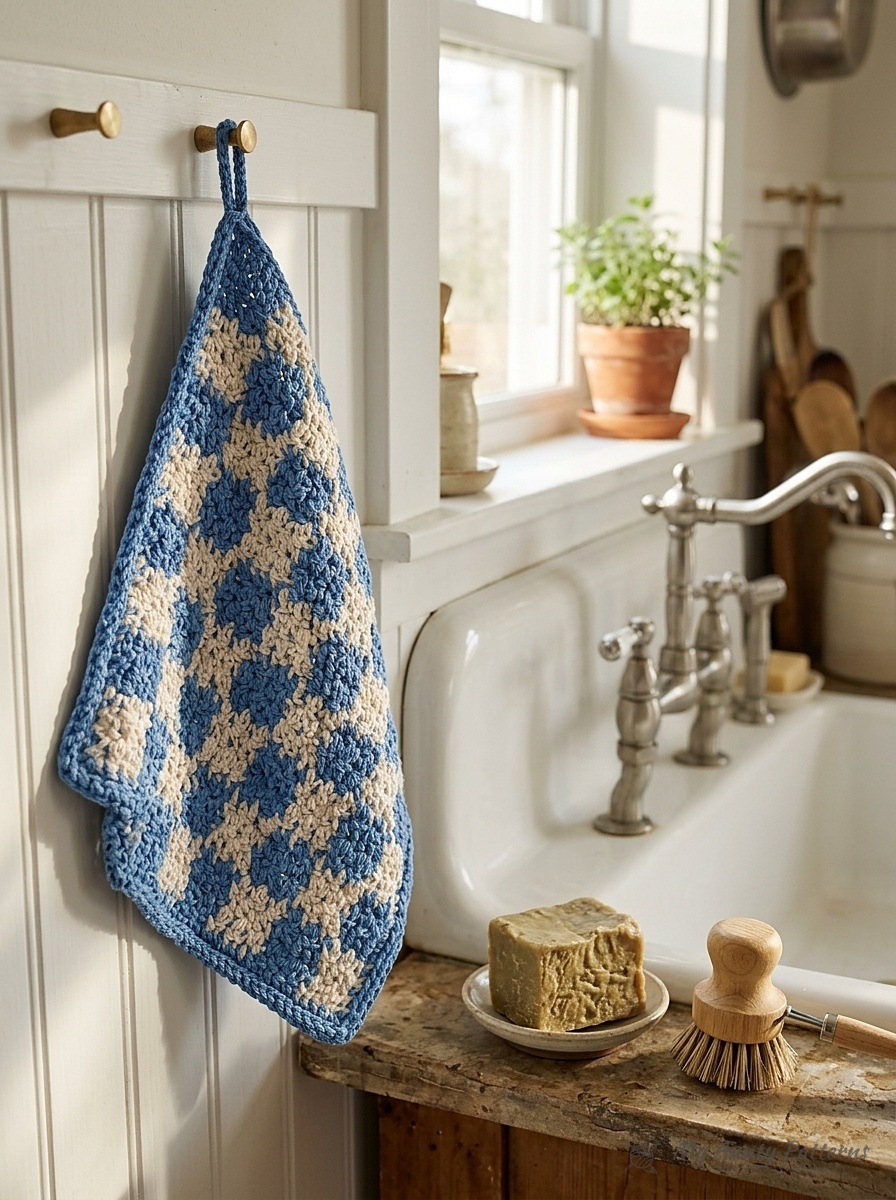
Kitchen Laundering & Care
- Machine Wash Warm & Tumble Dry Low: 100% worsted kitchen cotton is built for real daily scrubbing. Wash in warm water with like colors (wash dark navy/blueberry cloths once in cold water with a color-catcher sheet on the first wash) and tumble dry low or hang by the corner loop to dry.
Frequently Asked Questions
Is it normal to see the carried yarn peeking through between stitches?
Yes! In fact, the official design relies on the dark and light carried strands peeking slightly through the alternating squares to create the authentic “medium chambray” optical effect of woven gingham fabric.
Can I use this pattern to make a heavy pot holder or trivet?
Yes! Because tapestry crochet encloses a second strand of 100% cotton inside every single stitch, the fabric is already twice as thick as standard single crochet. Make the 8 × 8 inch trivet size from the table above (Chain 28) for a heat-resistant countertop hotpad.
READER COMMENTS & PATTERN QUESTIONS
Have a question about stitch counts, yarn substitutions, or sizing? Leave a comment below — Mary Ward reads and replies to every maker question!